

Australia’s top medical research body, the National Health and Medical Research Council (NHMRC), has recently announced it will review its 2017 advice concerning the safety of the fluoridation of Australia’s drinking water.
To be clear, the NHMRC has not concluded anything.
It has simply agreed to review its statement supporting the fluoridation of drinking water made almost a decade ago.
So, why are these fluoride guidelines under review again?
The NHMRC’s planned review was likely prompted by the following exchange between Senator Alex Antic and the NHMRC’s Acting CEO, Prue Torrance, at Senate Estimates for the Community Affairs Legislation Committee:
Senator Antic: “I want to ask some questions about the fluoridation of water across the country. I know that each state has different requirements and different levels, but the NHMRC has fluoridation guidelines, I think, and they substantially rely on reviews that go back to 2016-17. Since then there have been multiple prospective cohort studies that indicate that fluoride crosses the placenta and that prenatal fluoride exposure is associated with adverse neurodevelopmental outcomes, including reduced IQ in children. Does the NHMRC plan to review Australia's fluoridation guidelines and associated health advice any time in the future?”
Ms Torrance: Yes, we have commenced planning for a review of the statement.
Senator Antic: What evidence would you require before reconsidering the safety assumptions underpinning Australian fluoridation policy, particularly for pregnant women, infants and formula fed babies?
Ms Torrance: We will undertake a comprehensive review of the available evidence at this time and look to see what has emerged since the statement.
Senator ANTIC: In September 2024 the United States district court heard a case called Food & Water Watch v United States Environmental Protection Agency and found that fluoridation at 0.7 milligrams per litre posed 'an unreasonable risk of reduced IQ in children'. With that being the case, what steps are being taken to ensure Australian public health guidance reflects the most current evidence regarding potential neurodevelopmental risks associated with fluoride exposure during pregnancy and early childhood?
Ms Torrance: That sounds like a question for the regulators who actually decide on the state fluoridation levels. The current statement that NHMRC has supports fluoridation [sic] within the range of 0.6 to 1.1 milligrams per litre. That remains our current advice. We will be reviewing that.”1
The legacy media response was not “let’s see what the evidence says” but more “how dare you?! - tHe SciEnCE iS seTtLed!!!!”.
We are led to believe that simply reviewing the new evidence for the safety of water fluoridation will lead to tooth decay and scary trips to the dentist to have rotten teeth removed:
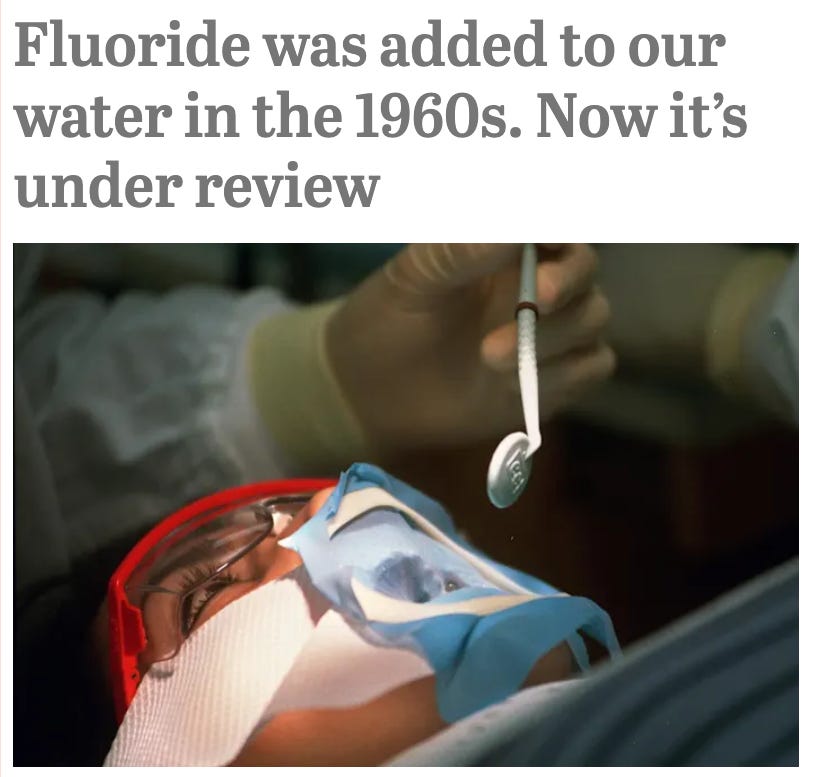
The headline above suggests that longevity is itself a form of evidence, and that a practice of sixty years’ standing should be beyond question.
History is less obliging.
Lobotomies, leaded petrol and asbestos also enjoyed decades of acceptance before evidence brought each to an end.
The caption to the alarming headline in the article is even more unbelievable:
“Dentists warn that unfounded anti-fluoride rhetoric is harming children, leaving some needing all 20 baby teeth removed due to preventable decay”.2
Rhetoric now rots teeth faster than sugar.
Which children? What was their diet like? Where was their fluoride? Why didn’t this dentist help them?
The article doesn’t say.
To debunk the challenges to the safety of water fluoridation, four key strategies have, so far, been deployed by the legacy media:
Ad hominem attacks;
Appeals to authority;
Cherry-picking; and,
Strawman arguments.
Ad hominem attacks
The first strategy deflects from what is being said to who is saying it.
“The hardline conservative politician [Antic] has previously been condemned for spreading “dangerous” ideas about vaccination and has spoken on an online radio station that publishes documentaries about the dangers of fluoride in drinking water.”3
It is implied that Antic’s dangerous ideas about “vaccination” mean his query about water fluoridation must also be dangerous. The article then links Antic to RFK Jr., implying guilt by association, which tells us nothing about fluoride.”4 It is an obvious attempt to defuse any engagement with the real matter; the planned review of the safety of water fluoridation.
Questions around the safety of water fluoridation, however, are not just from so-called “fringe” or “hardline conservative politicians”. Government bodies such as the U.S. National Toxicology Program have also raised these questions and, based on studies published through October 2023, concluded that there is moderate confidence in a link between higher fluoride levels and lower IQ in children, indicating that more research was needed on low exposures.
Appeal to authority
The legacy media article cites an Expert who comments on the safety of water fluoridation, dismissing concerns about “adverse neurodevelopmental outcomes”, “reduced intelligence in children” and the potential for fluoride to cross the placenta and harm unborn children.
The only problem is that this Expert happens to be a dentist.
Her name is Dr. Angie Nilsson, Vice-President of the Australian Dental Association and a strong supporter of fluoridation
Dentists are the right people to tell us about decay, however, how fluoride affects a developing brain is a question for epidemiologists and neurodevelopmental researchers: not dentists.
What’s worse is that Nilsson seems to horribly misunderstand the opportunity cost calculation in her assessment of the risks and benefits of water fluoridation, highlighting the inappropriateness of the appeal to her as the authority:
The risks
Water fluoridation, as acknowledged by the NHMRC, can be harmful.
Its “Drinking Water Guidelines” recommend a cap on fluoride concentration at 1.5mg/L.
Its 2017 recommendation for a concentration of between 0.6mg/L to 1.1mg/L is also an acknowledgement of a potential dangerous level of fluoride beyond this cap. More importantly, whether the margin of safety at current levels holds for the unborn is an open question.
The NHMRC also recommends lower fluoride levels in hotter parts of Australia (such as Darwin), because residents drink more water and so take in more fluoride.
Dose matters, and the NHMRC knows it.
So, it is established and agreed, even by the public health establishment and its institutions, that water fluoridation is risky beyond a certain concentration when swallowed.
The benefits
Fluoride helps prevent tooth decay, yet these benefits can be obtained through other means than water fluoridation.
Most of continental Europe doesn’t fluoridate its water, and Japan saw a 40-year decline in permanent-tooth decay among 12-year-olds without water fluoridation. Toothpaste, diet and dental services carried most of that improvement, showing that water fluoridation is not an essential strategy for preventing tooth decay.
In these two examples, fluoride was used topically, not added to drinking water to be swallowed by the whole population.
Antic was aware of this when he asked Ms. Torrance at Senate Estimates:
“Senator Antic: What consideration has been given—this might be something policy related—to nonsystemic alternatives that perhaps preserve the dental health benefits while reducing whole-of-population exposure?”
Ms. Torrance: The dental health benefits are taken into account during our reviews of evidence and are one of the reasons for the current recommendation for fluoridation of water within those limits that I referred to.
Senator Antic: But that, of course, requires everybody to be drinking the water. If it is the case that there are some concerns about the effects on, particularly, pregnant women and children, then there may be other alternatives to simply giving fluoride to every single Australian citizen rather than just those who perhaps need it. Is that something that's being considered, or is there a different alternative to just mass fluoridation of the water?
Ms Torrance: Once we've established an advisory committee to help us with the review, they'll be looking at what to prioritise, including whether to prioritise particular population advice or whether to have nationally consistent advice. So it is one of the things that's taken into consideration as we develop our advice.” [emphasis added]5
Hypothetically, if a new statement about the safety of water fluoridation is targeted at a particular population (for example, pregnant or breastfeeding mothers), then this would prompt serious questions about the decades of safety assurances about water fluoridation.
Evaluation
Clearly the risks of water fluoridation are real, acknowledged and cannot be ignored and the benefits it provides can be obtained through other means.
The second (and more relevant) Expert cited in the article is Dr Ian Musgrave, a molecular pharmacologist and toxicologist at the University of Adelaide, who laments “[i]t’s a very, very emotional issue, and unfortunately [how] actual facts are rarely used [in debates about water fluoridation]”.
In his defence of water fluoridation at its current concentrations (remember, it varies in Australia), he cites numerous studies which show its alleged safety for schoolchildren; however, Musgrave also falls victim to his own criticism of “facts rarely used” as he cites zero prenatal evidence showing the safety of fluoridated water for pregnant mothers and unborn children; which is precisely what this planned review by the NHMRC seeks to find out.
Cherry-picking
Cherry-picking, or extracting only the most convenient points from a study, whilst ignoring the inconvenient ones is another problematic aspect of this legacy media article and Dr. Nilsson’s take.
The study she cites did not measure how much fluoride study participants actually took in, it simply estimated exposure from where each child lived and the fluoride level of the local water supply.
Importantly, the study was never powered to determine the extent to which water fluoridation has a negative effect on IQ at all; rather, it was designed only to detect IQ differences larger than 3.75 points. Yet even reductions considerably smaller than this threshold, while potentially difficult to discern at the individual level, could have profound implications at the population level. A modest downward shift in average IQ across an entire generation of children could translate into thousands more falling below important cognitive thresholds.
In other words, the study’s inability to detect smaller differences should not be mistaken for evidence that such differences are either absent or inconsequential.
This study did not show there was no effect from water fluoridation.
Most importantly, the study counted fluoride exposure from birth.
So the study Dr. Nilsson cites as reassurance doesn’t test the very thing being reviewed: prenatal exposure to fluoride.
Citing it as proof that the question is closed is precisely the overreach the NHMRC review seeks to correct.
The strawman
A third problem of the legacy media article is the strawman argument put forward by Dr. Nilsson which completely misrepresents the concerns raised by Antic at Senate Estimates:
“It is actually a really alarming thing when someone’s saying to a pregnant woman, ‘you shouldn’t be having fluoridated water’”6
In fact, Antic said no such thing.
Nilsson also conflates the concerns about the safety of prenatal exposure to fluoride with tooth decay in children. After all, what pregnant mother still has their baby teeth?:
“We’re in a society now where there’s a lot of alarmist views, and people look into information that isn’t necessarily evidence-based . . . It’s decay that leads to pain and abscesses, that leads to a general anaesthetic and having all of their baby teeth – 20 teeth – taken out in one hit because they’re rotten . . . It’s just heartbreaking”7
Dr. Nilsson would surely know that fluoride can be dangerous and that’s precisely why dentists’ own daily practice treats swallowed fluoride as something to limit.
Every dentist tells patients to use a smear of fluoride toothpaste and spit it out, because fluoride does its work on the teeth and its risks come from swallowing it.
It is odd, then, to call it alarmist to ask whether swallowing it daily, from the womb onwards, deserves a second look.
Conclusion
Is it worth reviewing new evidence that a long-standing intervention could harm many, including the unborn, in order to protect a few?
The legacy media would answer “no”.
But that’s simply the question being asked of the NHMRC.
The public health establishment knows that most Australians can afford a balanced diet, toothpaste, floss and an education about the importance of dental care.
Many Australians might even afford a visit to the dentist for a regular check-up.
Some might have to wait to see a publicly-funded dentist.
But, most Australians could obtain the benefits of fluoride without swallowing it.
If the NHMRC reaffirms its support, it must be satisfied that the risks to pregnant and breastfeeding mothers, unborn children and everyone else are outweighed by the benefit.
We will be watching.
Australian Federal Parliament, “Community Affairs Legislation Committee - Senate Estimates 29 October 2026”, https://parlinfo.aph.gov.au/parlInfo/download/committees/estimate/30045/toc_pdf/Community%20Affairs%20Legislation%20Committee_2026_10_29.pdf;fileType=application%2Fpdf#search=%22committees/estimate/30045/0000%22, p. 14.
The Sydney Morning Herald, “Why Australia’s Water Fluoridation Guidelines are under Review”, https://www.smh.com.au/healthcare/why-australia-s-water-fluoridation-guidelines-are-under-review-20261029-p619p5.html, accessed 7 November 2026.
The Sydney Morning Herald, op. cit.
Ibid.
Australian Federal Parliament, op. cit.
The Sydney Morning Herald, op. cit.
Ibid.
There is no evidence that Fluoride in toothpaste or water "helps prevent tooth decay".
Colgate specialists told us in 2022 when discussing a competitor's "Tooth Mousse"
https://geoffpain.substack.com/p/fluoride-myths-unlearning-gospel
Humans should stop messing with nature, it’s that simple.